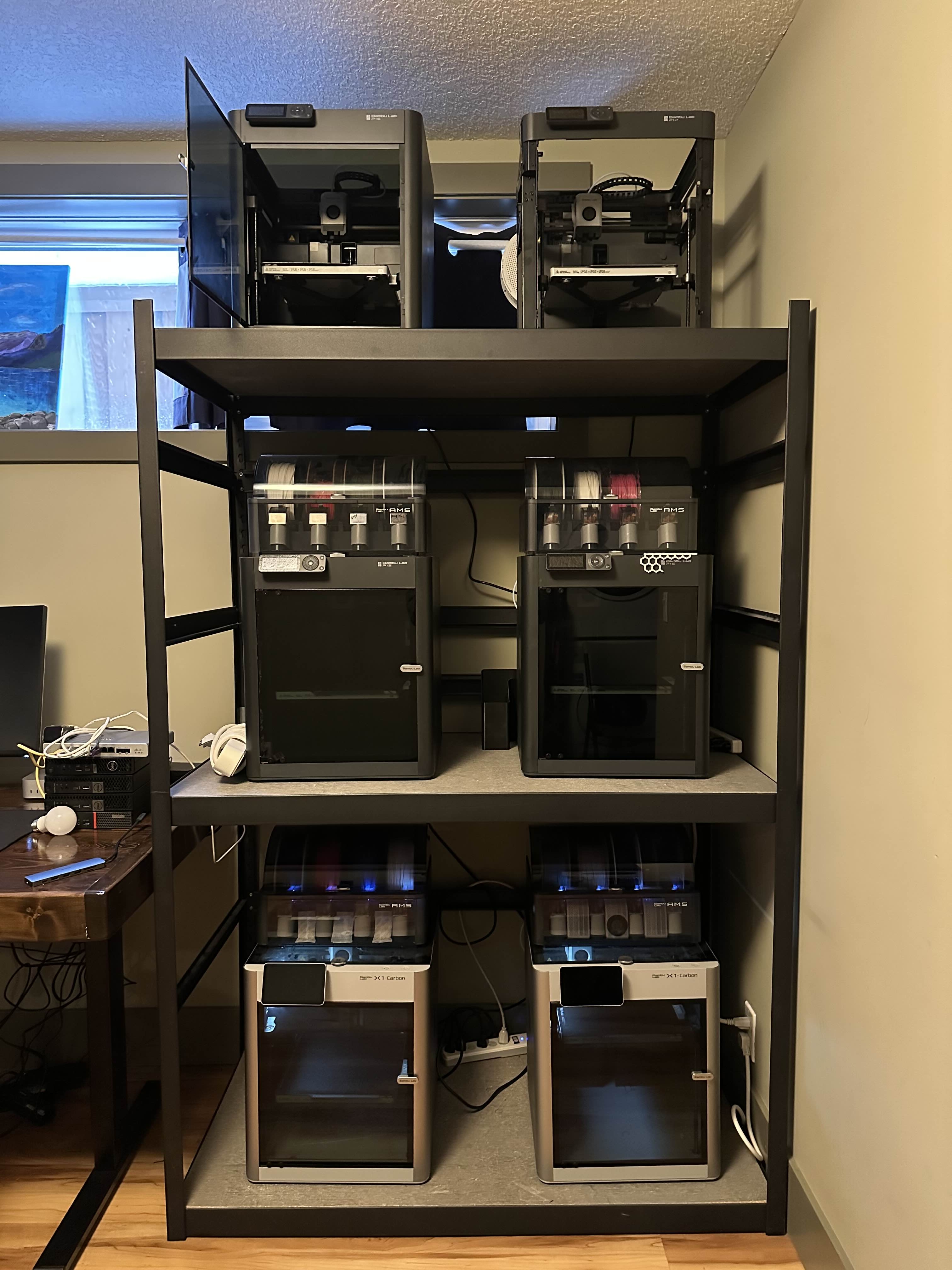
I started printing things for strangers in November 2022, while I was still at university. Almost four years later it’s six Bambu Lab printers on a steel rack, 886 conversations with 628 people, and a website.
For most of that time the business lived in Facebook Messenger. This September I pulled every conversation into a database and looked at what actually happened. This is what I’d tell someone starting today.
Sell where people already look
Nobody in Edmonton goes looking for a 3D printing service. They look on Facebook Marketplace for the thing they need. So that’s where all of it came from, apart from 11 Etsy sales.
I ran two kinds of listing. One was the service: “3D printing - Mods, Figurines, Designs, Functional parts and more”. The others were things I’d already made: a Deadpool mask, Warhammer terrain, a stand for retired golf balls, and a cooler shaped like a V8 engine, which got five listings of its own. Over four years that was 8 service listings and 18 product listings.
A product listing shows people what a printer can do better than a description of a service ever will.
Most messages are “Is this available?”
Marketplace fills in “Is this available?” for you, and a lot of people send it and disappear. Of the 800 conversations that were about a print, 429 never said, in words I could read, what the person wanted.
Only about a quarter of conversations ever got as far as a quote: 215 of 886. That’s normal. Answer fast, ask for a photo and a measurement, and don’t take the silence personally.
What people want
Here’s what the 371 conversations that did describe the job asked for. Four more wanted design only.
| Category | Requests | Average quote |
|---|---|---|
| Functional and replacement parts | 105 | $32 |
| Toys and tabletop | 58 | $57 |
| Cosplay and props | 49 | $70 |
| Automotive | 40 | $123 |
| Figurines | 31 | $54 |
| Home and garden | 23 | $67 |
| Electronics cases | 22 | $39 |
| Molds, tools and jigs | 22 | $43 |
| Signs and gifts | 17 | $79 |
The most common job is one small part that can’t be bought on its own. A valve connector, a socket cover, a pegboard stand, a mug lid, a fan holder for a PC.
Only about one in three of those people had a model file. The rest had a broken part and a phone. If you can only print other people’s STLs, you’re turning away two thirds of the work. Learn CAD.
Price small jobs low, and expect big ones to fall through
Half of my quotes came in at $40 or less. The middle half landed between $17 and $70.
| Quote | Share of jobs |
|---|---|
| Under $20 | 26% |
| $20 to $49 | 31% |
| $50 to $99 | 23% |
| $100 to $199 | 16% |
| $200 and up | 5% |
The big quotes are the exciting ones. A full size Formula 1 front wing for $500. A TV frame for $250. A Spider-Man face shell for $240. A wearable Turian mask for $200. Of my fourteen largest quotes, ten went quiet, one was declined and one is still open. Two went ahead: a $200 set of poker chips, and the $300 V8 cooler, which I’d already designed and listed.
The steady work is the $40 part.
What a $40 part costs
Filament runs $29 a kilo for PLA, $35 for PETG and $41 for ASA. I count machine time at $2.50 an hour, which covers wear, power and paying off the printer. A small part that takes 50 grams and two hours costs under $7 to make.
So the price isn’t really for the plastic. It’s for the conversation, the modelling, the reprint when the first one is a millimetre off, and getting it into someone’s hands. Most people picked up from me. Next came shipping, and fewer had it dropped off around the city.
Six printers also means one long print doesn’t hold up everyone else, and a batch of fifty clips can be split across all of them. Two are X1 Carbons and four are P1s. Four of them have an AMS, so one print can use four colours.
Write it down from day one
For three years my order book was Messenger. That works until you need to know who paid a deposit, what colour they wanted and when it’s due.
So I built PandaPrint, a phone first order tracker with a board that runs from inquiry to paid. To fill it, I imported a Facebook data export going back to 2022. The export only gives the listing name, which is the same across hundreds of threads, so a model read every conversation to recover what each person actually asked for.
Next, an agent reads the Marketplace inbox and creates orders for me. It can log quotes and deposits, but it can’t say anything was printed. It reads an inbox, it can’t see the printer. Everything it writes waits for my review.
If I did it again, I’d keep a spreadsheet from the first order. Reconstructing three years from an export is a lot of work to find out how many coolers you sold.
Get off Marketplace
Marketplace is free and full of buyers, but nobody finds a Marketplace listing from Google. So in September I built Print Alberta, with a quote form, real prices and guides like how much 3D printing costs in Edmonton and which plastic survives Alberta. The numbers on it come out of the same database.
If I were starting today
- List things you’ve made, not just a service.
- Answer fast and ask for a photo next to a ruler.
- Learn to model parts from photos. Most people don’t have a file.
- Quote small jobs low, and don’t build your month around the $500 quote.
- Track every order from the first one.